[vc_row][vc_column][vc_column_text css=””]November 13, 2025
Celebrating 45 Years of Literacy Quebec
Special 45th Anniversary 5 à 7 in Old Montreal
On November 5th, we gathered at the beautiful Phi Centre in Montreal’s Old Port for a special 5 à 7 marking our 45th anniversary. Surrounded by our members, partners, and supporters from around the province, we reflected on how far we’ve come and shared our excitement for the future of Literacy Quebec.

Left to right: Marie-Claude Gratton (Espace idées), Cimminnee Holt (Literacy Quebec), Elayne Fyckes (Literacy Quebec)

Left to right: Arielle Warten (Scattered Automatic Expression), Jessica Leahy (Literacy Quebec)

Left to right: Greg Graham (Western Quebec Literacy Council), Carole Valin, Steven Valin (RECLAIM Literacy)

Left to right: Anne Mackay (South Shore Literacy Council), Ruth Pelletier (Seniors Action Quebec)

Left to right: Alix Wong-Min (TALQ), Riley Dalys-Fine (TALQ), Anurag Dhir (McGill Faculty of Education), Gary Purcell (Suspicious Fish)

Left to right: Anne Mackay (South Shore Literacy Council), Charles Taker (Office of the Commissioner of Official Languages)
Below, you can find a message from our President, who delivered this speech during the event.
A Message from Our President, Wendy Seys

“Never doubt that a small group of thoughtful, committed citizens can change the world; indeed, it is the only thing that ever has.”
— Margaret Mead
In the late 1970’s, a group of directors from English Adult Education Centres came together with a common challenge: “Why are our students failing? Why are they dropping out?”
The conclusion: Adults were struggling with basic literacy skills.
And so began the volunteer literacy movement in Quebec’s English-speaking community. There was no funding, no staff, and no office — only intention, creativity, and a dedicated volunteer workforce. Volunteers who wanted to help people improve their literacy skills, and students who wanted to learn.
Each One Teach One
Community-based literacy groups began forming across Quebec based on the philosophy of “Each One Teach One.” The need for a network to connect these grassroots community initiatives soon emerged. A few tireless volunteers — our foremothers Grace Saabas, Freda Hudson, Martha Shufelt, Nina Nichols, and Marilee DeLombard, met at the Botanical Gardens, brown paper bag lunches in hand, and founded Laubach Literacy of Canada–Quebec—what is now Literacy Quebec. An organization founded and led by volunteers.
Eventually, there was funding, staff, and an office.
There have been many changes to the literacy landscape since those early days: technology, literacy definitions/statistics and surveys, philosophies, and methodologies.
The path forward for Literacy Quebec was not straightforward or without challenges. As an organization with strong ties to its grassroots mission, Literacy Quebec has sometimes struggled to find its voice and place amongst multiple stakeholders and competing priorities.
What started as an organization to connect the network, evolved. In the wake of the federal government’s defunding of the literacy and essential skills network in 2014, the literacy landscape felt a seismic shift. Literacy Quebec found itself in the position of being the English provincial literacy organization and was called upon to provide leadership in new spheres.
We have upscaled, upskilled, strategized, rebranded, and soul searched. Many of you here tonight have been part of our journey. Thank you.
Although there have been many changes throughout Literacy Quebec’s 45-year history, a few things have not changed: People in our communities with low literacy struggle to meet their goals. Community action makes a difference.
Why Does Literacy Matter in 2025?
- Low literacy impacts employment, health, justice, and citizenship.
- Literacy is foundational to a healthy society — contributing to economic growth, social inclusion, and community resilience.
The most recent international PIAAC survey indicates that 21.8% of Quebec adults aged 16-65 years old struggle with low literacy skills (more than 1 in 5, a statistic that is up almost 3% since the 2013 survey).
You might ask, “Why are the statistics getting worse?”
At Literacy Quebec, we ask the same question. The answer is complex. The definition of literacy, and how/what has been measured has shifted over time. Technology continues to demand new skills and presents new barriers for people with low literacy. Covid disrupted formal education and opportunities to strengthen literacy skills in the workforce. AI and social media have changed the way we engage with text, in ways we still do not fully understand. The answer is not to give up, but to evolve to meet the changing needs, and double-down on our efforts.
How Can YOU Be Part of the Literacy Solution?
- Join LQ and many other organizations across Canada in the effort to demand a national literacy strategy.
- Look at your own work through the literacy lens. Is your messaging and programming accessible to people with low literacy?
- Recognize and reject the discourse that narrowly portrays literacy as only an employment issue or marginalizes people with low literacy as broken or burdens on society.
If there is one key message that I hope you will take away from tonight’s literacy celebration, it is that we each have the power to make a difference.
Literacy unlocks possibilities.
More Celebrations: Professional Development with Our Members
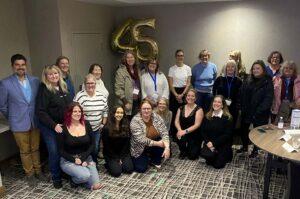
Left to right: Steven Valin (RECLAIM), Darlene Brown (TLE), Amanda Hunsaker (RECLAIM), Tabatha Brown-Gerkes (TLE), Elayne Fyckes (LQ), Antoinette Pettorelli (LQ Board), Jessica Leahy (LQ), Cimminnee Holt (LQ), Rachel Wagner (SSLC), Anne Mackay (SSLC), Angie Aucoin (LIA), Julia Asselstine (LU), Angelina Leggo (EQLC), Stephanie Lehner (LU), Julia Chiarella-Genoni (LU), Cathy Nolan (QCRC), Mariah Patch (YLC), Madelaine Labonté (LLC), Enza Ciampanelli (TLE), Kimberly Lloyd (LLC)
On November 6th, we continued the celebration with a day of professional development with our members at the AC Hotel in Montreal’s Old Port. Members received a copy of our updated Key Messaging Toolkit, took part in an Impact Evaluation Workshop with Marie-Claude Gratton from Espace idées, and joined Lisa Marcovici from Rekinéxion for a fun, movement-based Brain Gym session.
It was an inspiring day of learning and connection— the perfect way to close our 45th anniversary celebrations.[/vc_column_text][/vc_column][/vc_row]